BRENT FUNDING PARTNERS
Your partner for alternative funding solutions.
The Strategic Capital Report | Unlocking Hidden Capital: The Direct Guide to Equipment Sale-Leasebacks
Yul Gentle Managing Partner | Strategic Business Finance Broker
7/2/20264 min read
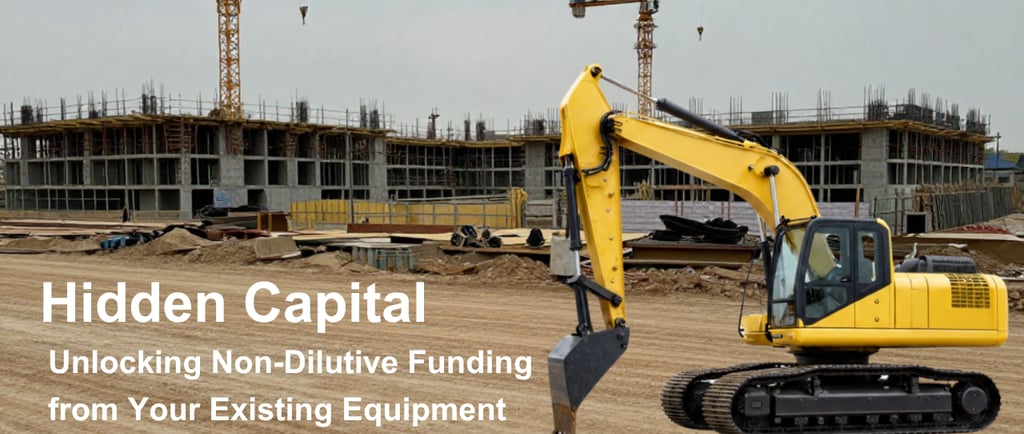
As we cross into July 2026, we are still seeing traditional commercial banks enforce highly restrictive lending standards. Over the last few weeks, this report has focused on cash flow underwriting and how to navigate strict bank rules. This week, we are taking a straightforward look at a specific financial tool built for companies that own physical machinery, vehicles, or equipment: the Equipment Sale-Leaseback.
The concept is basic: your company sells its owned equipment to an alternative lender for a lump sum of cash, and you immediately lease it back. You never stop using the machinery, your daily work is never disrupted, but you instantly turn a physical asset into liquid working capital.
To use this tool safely, you need a complete view of how it works, what it takes to qualify, and the real accounting and tax trade-offs involved.
1. What It Is and How It Works:
An equipment sale-leaseback follows a clear, predictable sequence from the initial application to the final funding:
Asset Selection: You identify the specific, high-value machinery or vehicles your business owns that are free and clear (or close to it).
Professional Appraisal: A lender reviews the equipment to establish its current liquidation or fair market value.
The Sale: You transfer ownership of the assets to the lender in exchange for a lump-sum cash injection.
The Leaseback: You sign a lease agreement that allows your business to keep using the machinery completely uninterrupted on your floor.
End-of-Term Options: Once the lease term is over (typically 36 to 60 months), your buyback structures will dictate whether the deal is treated as a true lease or a standard loan on your books.
2. The Qualification Process:
Unlike traditional bank loans that rely heavily on strict corporate debt-to-equity ratios, a sale-leaseback is asset-driven. Underwriters care much less about a perfect credit score and far more about the value of the machinery itself.
Ownership Status: You must own the assets outright, or have very small remaining balances that can be fully paid off using the closing proceeds.
Market Liquidity: The items need to have a clear secondary resale market. Lenders look for common, mainstream assets (like standard CNC lines or titled trucks) rather than highly rare or custom-built gear.
Credit Flexibility: Because the funding is secured by hard assets, credit score requirements are secondary. Lenders regularly approve scores down to the 500s or 600s if the equipment value is strong.
Revenue Verification: While asset value is the priority, your bank statements must demonstrate consistent monthly revenue to prove your cash flow can comfortably support the new lease payment.
3. Expected Funding Timelines:
Because this structure avoids the heavy committee reviews of conventional banking, it is built to move efficiently. The timeline is driven entirely by the size of the deal and the layout of the paperwork:
Initial Term Sheet: Usually delivered within 24 to 48 hours after you submit your equipment list and original invoices.
Small-to-Mid Tickets ($50,000 to $250,000): Typically funds in 3 to 7 business days for clean-titled commercial vehicles or standard construction gear. If your paperwork is ready, alternative lenders can move very quickly.
Large Industrial Tickets ($250,000 to $1M+): Typically takes 10 to 18 business days. This extra time is required because the lender must run multi-jurisdictional UCC-1 lien searches and send out a certified technician for a formal, on-site physical appraisal to verify the equipment's condition.
4. Upsides vs. Downsides to Consider:
To make an optimal capital decision, business leaders have to weigh immediate cash against long-term operational, tax, and accounting realities:
The Upsides
Immediate Capital: Unlocks 70% to 90% of your equipment's appraised value in cash, giving you immediate funding to deploy into payroll, inventory, or new contracts.
Operational Continuity: Production floors and daily transport logistics never pause or change. The machinery stays exactly where it is.
Expense Predictability: Provides fixed monthly payments that streamline long-term operational budgeting and protect your working capital.
The Downsides
FASB Balance Sheet Impact: Under modern FASB ASC 842 rules, all leases over 12 months create an immediate Right-of-Use (ROU) asset and a matching lease liability on your balance sheet. It no longer qualifies as "off-balance-sheet" financing.
The Repurchase "Failed Sale" Trap: If your leaseback contract guarantees a fixed, low-price buyout option at the end, ASC 842 classifies the deal as a "failed sale." The equipment stays on your books as a fixed asset, and the cash injection must be recorded strictly as debt financing.
Immediate Recapture Tax Liability: Under IRS Section 1245, selling machinery for more than its adjusted tax basis triggers an immediate depreciation recapture tax taxed at ordinary income rates. This is especially punishing for assets previously written off completely via Section 179 or Bonus Depreciation.
Severe Default Risk: Surrendering your ownership title means a single material default allows the lender to rapidly repossess critical machinery right off your floor, risking an instant operational shutdown.
5. Target the Ideal Asset Classes:
This structure yields the highest loan-to-value ratios in capital-intensive sectors utilizing long-lived physical assets:
Construction & Excavation: Yellow iron, excavators, cranes, bulldozers, and commercial dump trucks.
Manufacturing & CNC: Automated production lines, milling machines, heavy presses, and stamping equipment.
Transportation & Logistics: Semi-trucks, trailers, delivery fleets, and warehouse material handling hardware.
Medical & Laboratory: MRI machines, CT scanners, and high-value healthcare or laboratory hardware.
In Summary
Sourcing capital in today's selective market requires looking closely at your entire balance sheet. If traditional banks are slowing you down, a structured asset-backed approach can give you the liquidity you need to stay competitive. However, structuring the buyback terms incorrectly can unintentionally trigger loan classifications on your books or unexpected tax bills with the IRS. Always map out the end-of-term buyout rules with your CPA before signing.
As a reminder, my role at Brent Funding Partners is focused on helping clients secure non-dilutive debt, asset-backed funding, and alternative capital structures to scale their business.
Are you currently operating an asset-heavy business and finding it difficult to secure traditional bank lines this quarter? Let’s discuss your experiences: Email me directly: ygentle@brentfundingpartners.com
Sources & Verified References:
Equipment Leasing and Finance Association (ELFA): Tracking asset valuation standards, equipment demand trends, and standard leaseback structure criteria | https://www.elfaonline.org
Internal Revenue Service (IRS): Reviewing asset dispositions, Form 4797, and Section 1245 property codes governing depreciation recapture | https://www.irs.gov
Financial Accounting Standards Board (FASB): Accounting presentation criteria and ASC 842 lease standard definitions for operating vs. finance structures | https://www.fasb.org
Federal Reserve Board Economic Data: Credit tightening context and Senior Loan Officer Opinion Survey on Bank Lending Practices (SLOOS) | https://www.federalreserve.gov
Disclaimer: Brent Funding Partners provides strategic financial information for educational purposes. All business owners are advised to consult with professional tax, legal, or financial advisors regarding your specific business capital structure and financial strategy. The metrics, guidelines, and frameworks provided reflect standard mid-2026 commercial financial market structures.
Contacts
678.692.7994
info@brentfundingpartners.com
BRENT FUNDING PARTNERS
Your partner for alternative funding solutions.