BRENT FUNDING PARTNERS
Your partner for alternative funding solutions.
The Strategic Capital Report | Alternative Business Lines of Credit as a Liquidity Buffer
As we progress through the second quarter of 2026, the primary challenge facing many small and mid-sized business owners isn't a lack of top-line revenue—it is the structural timing of capital.
Yul Gentle Managing Partner | Strategic Business Finance Broker
5/24/20264 min read
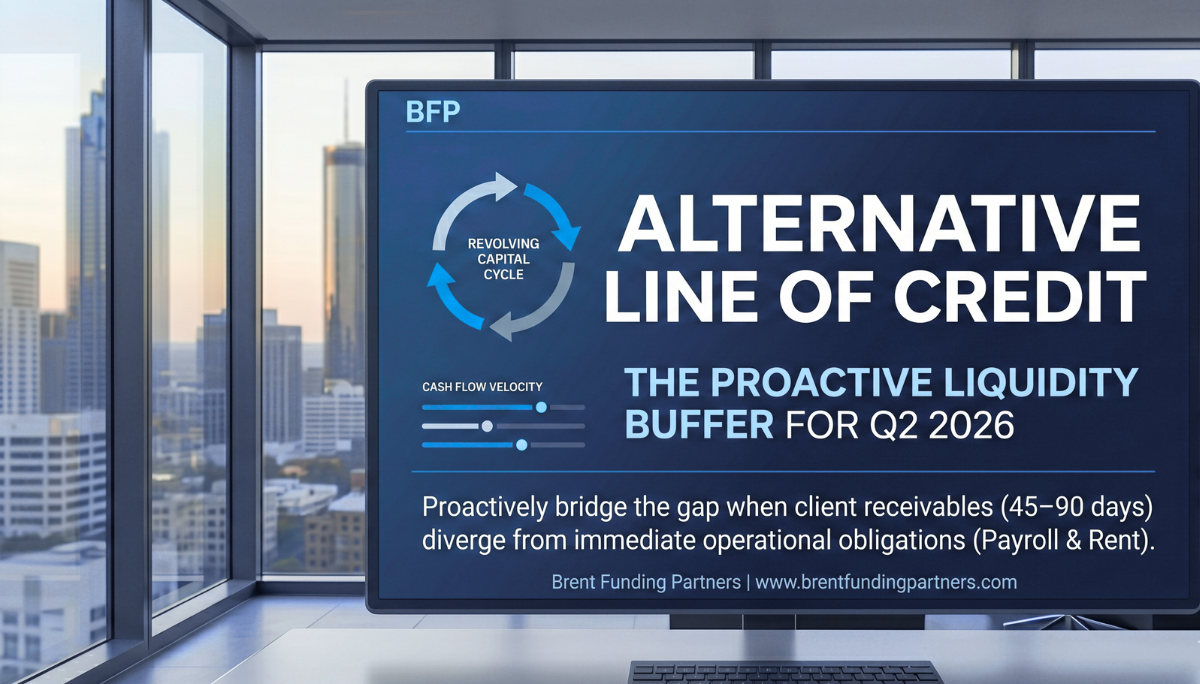
Data from the Federal Reserve Board’s Senior Loan Officer Opinion Survey (SLOOS) highlights that commercial banks have sustained tighter lending standards and more strict terms for commercial and industrial (C&I) credit portfolios [1]. Additionally, the Federal Reserve’s 2026 Report on Employer Firms reveals that 56% of all financing applicants seek capital primarily to meet operating expenses, signaling a widespread need to bridge the cash conversion cycle [2].
For asset-light firms, this contraction in traditional banking exposure highlights a common operational risk: the Cash Flow Mismatch. This week, let's analyze how Alternative Business Lines of Credit (LOCs) function as a flexible, on-demand debt facility to manage short-term working capital requirements.
1. The Anatomy of a Cash Flow Mismatch
A cash flow mismatch occurs when a company's accounts receivable timeline diverges from its fixed accounts payable obligations. In business models such as professional services, government contracting, logistics, and high-growth B2B manufacturing, client contracts routinely demand 45- to 90-day payment terms.
Conversely, core operating expenses—including payroll, vendor obligations, and facility overhead—are structurally rigid and occur on fixed 14- to 30-day cycles. When an enterprise expands, this timing gap expands with it. Without a dedicated revolving credit facility, businesses are often forced to delay vendor fulfillment or artificially restrict growth simply to preserve baseline daily liquidity.
2. Debt Facility Breakdown: Traditional vs. Alternative LOCs
Traditional bank revolvers are built on static, historical risk models. Securing or renewing a bank line typically requires multi-year profitability trends, extensive corporate relationship histories, and significant physical asset collateral (such as real estate or equipment) [1].
To address these barriers, the alternative commercial finance sector has expanded, with Federal Reserve data indicating that the share of small business credit applicants utilizing online FinTech and alternative institutional lenders has grown to 29% [2]. This alternative approach focuses on different underwriting criteria:
Forward-Looking Cash Velocity: Alternative underwriters prioritize real-time transaction velocity and net cash flow consistency over historical, tangible asset valuations.
Streamlined Data Integration: Instead of multi-month committee reviews, alternative facilities leverage secure ledger and bank data integrations to analyze cash flow health, compressing underwriting timelines from months to days.
The Collateral Structure: Institutional credit market frameworks show that alternative direct lenders predominantly secure facilities using broad blanket liens on business assets. In contrast, conventional commercial banks typically require specific hard collateral, relying heavily on physical asset registries, equipment titles, or commercial real estate equity [3].
3. Evaluating the Structure of an Alternative Revolver
An alternative line of credit is a powerful liquidity tool, but its structure must be precisely aligned with the business's net operating margins. A sophisticated analysis of a revolving facility focuses on three key components:
Draw-Based Pricing: Unlike a term loan where interest accrues on the full principal from day one, an LOC should only incur costs on the specific capital actively drawn down.
Repayment Cadence: Alternative structures can feature weekly, bi-weekly, or monthly repayment cycles. It is critical to ensure that the repayment velocity matches your incoming clearing cycles; overly aggressive daily ACH sweeps can inadvertently restrict the very liquidity the line was designed to provide.
Cost of Capital Alignment: Alternative non-bank credit lines carry a structural premium above traditional bank revolvers. Industry data from the Secured Finance Network (SFNet) highlights this contrast, showing average bank lender yields near 3.0% of outstandings compared to average institutional non-bank yields of approximately 10.7% [3]. A successful deployment requires ensuring that the total cost of pulling capital remains comfortably below the net margin of the contract or inventory turn being funded.
4. The 2026 Market Outlook
6.75% — Current Bank Prime Rate [4]
Per the Federal Reserve Board's H.15 data, the prime rate remains steady at 6.75% [4]. In this highly selective economic climate, a fundamental principle of capital structuring holds true: The absolute best time to secure a revolving line of credit is when your balance sheet is strong and your liquidity is high. Waiting until a working capital deficit emerges signals elevated risk to underwriters, limits your structural options, and reduces your leverage. Proactively establishing a flexible capital reservoir ensures your enterprise remains agile enough to capture market share and protect payroll when obligations arrive ahead of revenue.
Ready to see if a flexible line of credit is a potential fit for your business? BFP focuses on analyzing complex capital structures so you can make an informed, strategic decision for your business. Click below to take the 2-Minute Capital Assessment. We will analyze your current debt schedule and help you identify the right alternative or private credit partners for your needs.
Email me directly at ygentle@brentfundingpartners.com to schedule a brief consultation.
Bibliography & Sources
[1] Commercial Bank Lending Standards: Federal Reserve Board — Senior Loan Officer Opinion Survey on Bank Lending Practices (SLOOS), released May 4, 2026. Documenting C&I credit tightening trends. View Federal Reserve SLOOS Data
[2] Small Business Capital Demand: Federal Reserve System — 2026 Report on Employer Firms (Based on the Small Business Credit Survey), released April 2026. National metrics on operating expense demand (56%) and alternative/fintech lender adoption (29%). Read the Federal Reserve Market Report
[3] Non-Bank Market Metrics & Structural Benchmarks: Secured Finance Network (SFNet) — Q4 and Full-Year Asset-Based Lending Industry Survey, report published April 13, 2026. Documenting bank vs. non-bank asset-based lending asset structures and yield metrics. View Secured Finance Network Industry Data
[4] Macro Interest Rate Data: Federal Reserve Board — H.15 Selected Interest Rates, data current through May 2026. Verifying current commercial bank prime rate benchmarks at 6.75%. View Federal Reserve H.15 Data
Contacts
678.692.7994
info@brentfundingpartners.com
BRENT FUNDING PARTNERS
Your partner for alternative funding solutions.